|
|
马上注册,结交更多好友,享用更多功能,让你轻松玩转社区。
您需要 登录 才可以下载或查看,没有账号?注册

×
作者:微信文章

Built to host the World Artificial Intelligence Conference, the West Bund Convention Center was designed with the help of AI technology.
A dark, diamond-like structure has risen on the banks of Shanghai’s Huangpu River. Glittering by day and inky black after sunset, its glass facade evokes the angled geometry of a gemstone. But this sculptural form is neither rooted in nature nor even entirely designed by humans.
It is — in part, at least — the work of artificial intelligence.
The West Bund Convention Center is a new showpiece venue in a once-industrial Shanghai district now central to China’s push for AI supremacy. The West Bund neighborhood already houses the aptly named AI Tower skyscraper and a 13-million-square-foot “AI Valley” expected to one day house tech enterprises worth a combined $14 billion.
So, when American architecture practice Skidmore, Owings & Merrill (SOM) was commissioned to design a home there for the annual World Artificial Intelligence Conference, one of the industry’s biggest events, it seemed only fitting to use AI.
“We had the vision to actually use artificial intelligence as a primary driver for the expression of the building,” said design partner Scott Duncan on a video call from Chicago, where the firm is headquartered. The venue hosted its first AI conference, while still under construction, in July and was completed in October.

Some of the hundreds of AI-generated proposals, each offering a subtly different solution to the design objectives laid out by the building's architects.
For both practical and ethical reasons, the architecture sector has, thus far, been conservative about AI-powered design. But SOM — which has designed some of China’s best-known skyscrapers, including the pagoda-inspired Jin Mao Tower, also in Shanghai — is among a growing number of practices using the technology to save time, reduce waste and solve complex design problems.
Instead of giving AI full creative license, the architects assign it very specific tasks, outlining fixed parameters and then leaving it to produce hundreds, even thousands, of possible solutions.
For the West Bund Convention Center’s facade, for example, the design team began by defining constraints that acted as “rules” for the AI — everything from site dimensions to the height of meeting rooms. The architects then developed algorithms around six key objectives: improving occupants’ views, maximizing floor space and increasing the amount of sunlight hitting the facade, among others.
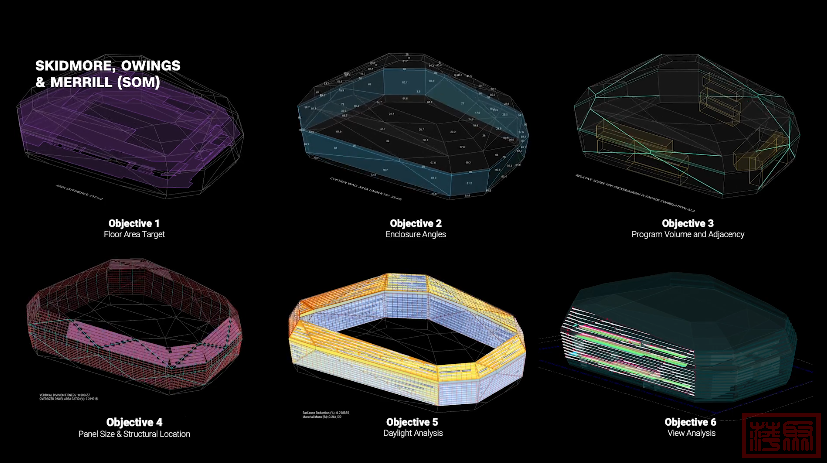
AI calculated the impact that adjustments to the exterior had on a variety of factors, including the conventions center's floor area and sun exposure.
Such goals can (and often do) conflict with one another. Changing the angle of a glass panel, for instance, might improve views but also reduce sun exposure. But through a process called “multi-objective optimization,” AI can analyze — to an almost infinite degree — the best possible compromises. “It’s like algebra,” said Duncan. “You have multiple equations and multiple unknowns, and you can solve for them all at once.”
Leaving the algorithms to “think” overnight, the SOM architects awoke to hundreds of subtly different proposals, each one scored against their objectives. Duncan estimates they were presented with more than 800 iterations. “And we could have generated millions, if we had an unlimited time schedule.”
Narrowing down the options and picking a winner still required a human eye. After all, the designers wanted an “aesthetically pleasing” design, despite their many functional requirements, the architect explained.
“We selected the one we thought was most beautiful and looked the most elegant in its setting. And that’s something that really can’t be automated,” he said, arguing that AI’s role will not replace human creativity.
“The violin doesn’t play itself,” he said, adding: “The algorithm doesn’t know what beauty is.”
Art or science?
SOM estimates that using AI for the West Bund Convention Center saved weeks in design time and research.
This kind of “parametric” design (whereby algorithms work within defined parameters) can also be used to improve buildings’ energy performance or reduce the amount of carbon-intensive concrete and steel required to build them.
But the benefits extend far beyond efficiency, Duncan argued, calling AI both “a time saver and a design enhancer.” Algorithms can produce a degree of randomness on a scale that human architects simply can’t match, he added. “It has a level of precision that would have been hard to achieve at all if we were doing this manually.”

The West Bund Convention Center is part of a wider district — known as West Bund AI Valley — aimed at the rapidly developing AI sector.
Parametric design is just one way architects are employing AI technology. It can be — and is being — used in everything from idea generation to 3D simulations testing how structures perform in high winds. The London-based designers behind the world’s first “fully AI-driven” architectural project, a villa complex in Slovenia, even asked artificial intelligence to analyze an image database of the region’s buildings to help generate ideas in keeping with the local heritage and style.
Yet, the profession at large remains tentative about AI’s adoption. A recent report by the American Institute of Architects (AIA) found that although almost 70% architects were optimistic about AI, and around half have experimented with it, only 6% use it regularly for their jobs. A similar 2024 survey by the Royal Institute of British Architects (RIBA) reported comparatively higher uptake in the UK, though the majority (59%) still said their firms never use AI.
The architects’ concerns were wide-ranging. RIBA’s members were worried about job losses and their work being imitated. Nearly 90% of the AIA’s respondents cited fear of inaccuracies and unintended consequences of AI outputs, as well as the question of “authenticity.” Elsewhere, critics have suggested that the use of pre-existing datasets may reinforce biases or stifle innovation.

The venue hosted the World Artificial Intelligence Conference for the first time in July.
Some of these concerns speak to architecture’s role as both a science and an art. While few people would object to AI accelerating the discovery of new medicines, AI-generated paintings are far more likely to unsettle. (Earlier this year, thousands of people signed an open letter calling on Christie’s auction house to cancel a sale dedicated solely to AI art.) Similarly, AI’s critics worry the technology threatens the character of building design and the human-centrism at the heart of architecture.
Wider adoption is seemingly inevitable, however. Many of the 3D modeling programs architects rely on have already started integrating AI tools. Since designing the West Bund Convention Center, SOM — the firm behind buildings like Chicago’s Willis Tower, New York’s One World Trade Center and Dubai’s Burj Khalifa, as well as a soon-to-open new headquarters for Chinese ecommerce giant Alibaba, also in Shanghai’s West Bund district — has launched a proprietary in-house AI program, dubbed Natalie, to assist with everything from facade shading (which dictates the amount of sunlight hitting a building’s exterior) to floor plans.
“The user experience of a building incorporates millions of different factors and millions of different objectives,” Duncan said. “So we’re really just limited by computing power at this point.”
CNN / December 2, 2025 |
|
 简体中文
简体中文 繁體中文
繁體中文 English
 Deutsch


 窥视卡
窥视卡 雷达卡
雷达卡 发表于 2025-12-10 04:23
 提升卡
提升卡 置顶卡
置顶卡 沉默卡
沉默卡 喧嚣卡
喧嚣卡 变色卡
变色卡 抢沙发
抢沙发 千斤顶
千斤顶 显身卡
显身卡