|
|
马上注册,结交更多好友,享用更多功能,让你轻松玩转社区。
您需要 登录 才可以下载或查看,没有账号?注册

×
作者:微信文章
新教师基金“一带一路”项目首次线上研讨会
聚焦人工智能与社会情感学习的伦理边界与教育公平
为持续推进“一带一路”教育人文交流,深化人工智能时代教师专业发展议题,苏州大学新教师基金“一带一路”教师职业发展项目于2026年1月11日成功举办首场 NEI双月线上研讨会(New Education Initiative Bi-Monthly Dialogue)。本次会议以“人工智能与数字技术如何在不加剧教育不平等的前提下支持社会情感学习(SEL)”为主题,通过线上方式汇聚来自不同国家与教育体系的一线教师、教育研究者与政策实践者,展开了一场兼具思想深度与现实关怀的国际对话。
本次研讨会由苏州大学新教师基金“一带一路”教师发展项目发起,是在连续三年举办线下国际研讨班的基础上,首次尝试以常态化线上机制延展专业交流,旨在推动项目从“年度集中交流”走向“可持续的专业共同体建设”。
The First Bi-Monthly Dialogue of the NEI Belt and Road Project Successfully Held
To further promote people-to-people educational exchange under the Belt and Road framework and deepen discussions on teacher professional development in the age of artificial intelligence, the NEI Belt and Road Teacher Development Project of Soochow University successfully held its first NEI Bi-Monthly Dialogue on 11 January 2026.
The seminar, themed “How Can AI and Digital Technologies Support Social and Emotional Learning (SEL) Without Widening Educational Inequality?”, brought together frontline teachers, education researchers, and policy practitioners from different countries and education systems in an online format. The dialogue combined conceptual depth with strong ethical and practical concern, fostering a thoughtful international exchange.
Initiated by the NEI Belt and Road Teacher Development Project, this online seminar marks the first step toward a regularized online dialogue mechanism, building on three consecutive years of in-person international training programs. The initiative aims to extend professional exchange beyond annual events and cultivate a sustainable international professional learning community.
一、以问题为起点:
当AI赋能SEL,教育该站在哪里
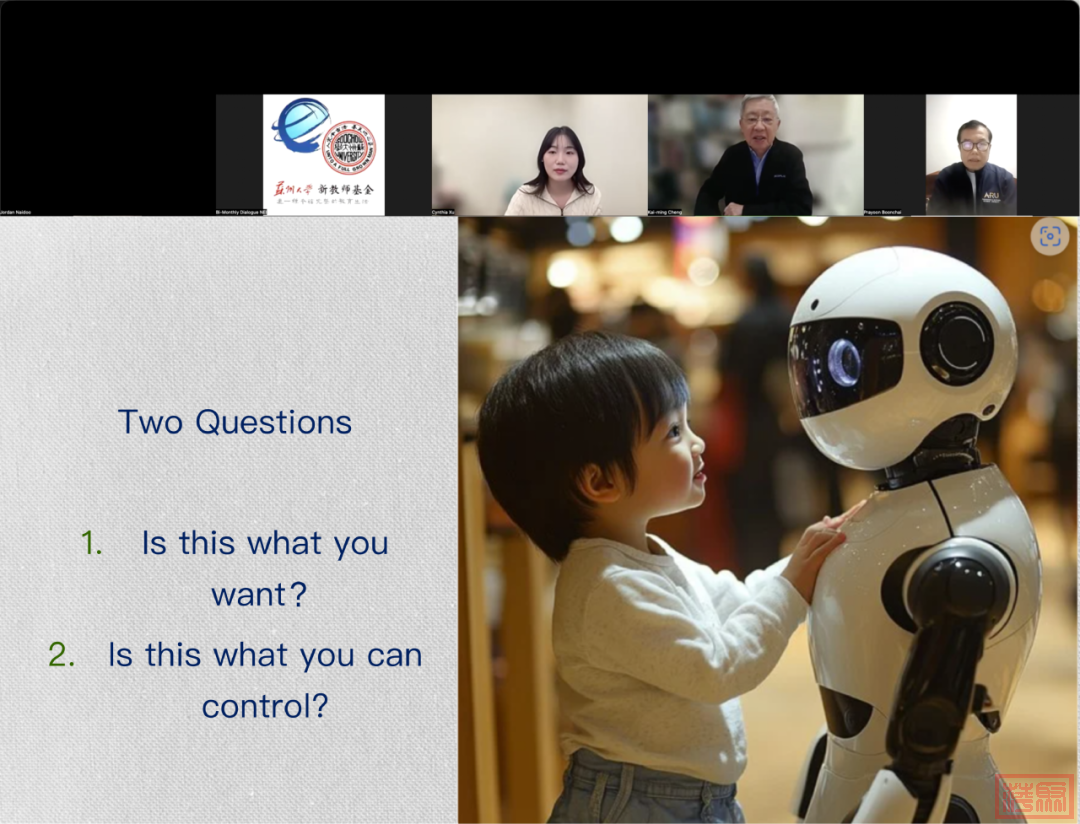
会议伊始,项目主持人向来自不同国家与地区的与会者表示欢迎,并介绍了双月研讨会设立的初衷:在年度项目之外,构建一个允许犹豫、保留分歧、强调反思而非结论的专业讨论空间。
在主题报告中,香港大学荣休教授、前副校长程介明并未急于给出结论,而是反复提醒听众:“在人工智能与社会情感学习(SEL)的问题上,也许我们最需要的,不是答案,而是足够严肃的问题。”
他以一个意味深长的情境开场:当孩子把一个始终温和、从不责备、永远耐心回应的 AI 视为“朋友”,甚至主动依赖其情感陪伴——这,究竟是不是我们心目中的理想教育?更重要的是,在这一切悄然发生的过程中,人类是否仍然拥有控制权?
通过“孤独的青少年”与“婚姻冲突中的成人咨询”两个模拟案例,程介明教授展示了生成式 AI 在情绪回应与咨询对话中的高度“类人化”表现:它可以共情、可以陪伴、可以持续对话,甚至在关键时刻主动提示风险、引导当事人回到现实中的支持系统。
但正因如此,问题变得更加尖锐:
当算法表现得比人更耐心、更稳定,我们是否反而更需要警惕?
在程介明教授看来,AI 的优势并不意味着“可以放心交付”。它没有情感,也没有价值立场,所有看似温暖的回应,本质上都来自算法与数据的组合。当情绪支持涉及价值判断、关系边界与伦理选择时,人类的责任无法被技术替代。
因此,他并未简单地赞成或反对 AI 进入 SEL 领域,而是反复强调“使用情境”的重要性:
关键不在于“用不用”,而在于“谁在场”“谁负责”“是否可控”。
在报告的最后,程介明教授将问题再次抛回给所有教育者:
当学生已经在现实中主动转向 AI 寻求情感支持,教育真正的挑战,不是阻止技术,而是重新确认——人在其中,究竟扮演什么角色。
I. Starting from Questions: When AI Empowers SEL, Where Should Education Stand?
At the opening of the seminar, the project host welcomed participants from different regions and outlined the purpose of the bi-monthly dialogue series: to create a professional space that allows hesitation, preserves disagreement, and values reflection over quick conclusions.
In his keynote address, Kai-ming Cheng, Emeritus Professor and former Vice-President of the University of Hong Kong, deliberately refrained from offering ready-made answers. Instead, he repeatedly reminded the audience:
“I’m here to ask questions, not to provide answers.”
He began with a thought-provoking scenario: when a child regards an AI—always gentle, never scolding, endlessly patient—as a “friend” and even becomes emotionally dependent on it, is this truly the kind of education we envision? More critically, as such interactions quietly become part of everyday life, do humans still retain meaningful control over the process?
Through two hypothetical cases—a lonely adolescent and an adult seeking marital counseling—Professor Cheng illustrated the increasingly “human-like” performance of generative AI in emotional response and counseling dialogue. AI can express empathy, sustain long conversations, and even identify risk and redirect users to real-world support systems at critical moments.
Precisely because of this, the question becomes more pressing:
When algorithms appear more patient and more stable than humans, should we in fact be more cautious rather than less?
In Professor Cheng’s view, AI’s apparent strengths do not justify unconditional trust. Lacking genuine emotion and value judgment, all seemingly warm responses ultimately stem from algorithms and data. When emotional support involves ethical judgment, relational boundaries, and value-laden decisions, human responsibility cannot be delegated to technology.
Rather than endorsing or rejecting AI in SEL outright, Professor Cheng emphasized the importance of contextualized use—who is present, who bears responsibility, and whether the process remains controllable. In closing, he returned the question to educators:
When students are already turning to AI for emotional support in real life, the core challenge for education is not to block technology, but to rethink what role humans should play within it.
二、从研究视角回应:
技术能做什么,不能替代什么

随后,苏州大学教育学院教授、教育技术系主任秦炜炜从教育技术研究的视角,系统回应了人工智能与数字技术介入社会情感学习(SEL)所带来的潜力、风险与治理路径。
他指出,随着数字技术尤其是 AI 的广泛应用,SEL 已不再仅限于“人与人之间的社会情感关系”,而逐步演变为“人—技术—AI”共同参与的复杂互动结构。在这一背景下,研究显示,AI 在若干方面确实展现出积极潜力:
它可以更好地“看见个体差异”,但前提是我们知道它在看什么。
基于最新研究进展,秦炜炜教授梳理了多种具有实践价值的应用方向:从基于 AI 的个性化学习路径与即时反馈,到情绪识别与情绪调节支持;从辅助性技术对多样化学习者的包容支持,到游戏化与虚拟角色参与的 SEL 学习场景。这些技术在一定条件下,有助于提升学生参与度、情绪调节能力,并在一定程度上缓解教师在情绪支持方面的长期压力。
但他随即强调:技术潜力越大,治理问题就越无法回避。
在 SEL 场景中,AI 的风险尤为集中而敏感:
如果接入条件不均,AI 可能首先放大的不是支持,而是不平等。
数字鸿沟、算法偏见、情感与行为数据的隐私风险,以及教师对 AI 教育用途理解不足,都可能削弱技术原本应有的教育价值,甚至对弱势学生群体造成新的排斥。同时,研究也警示,对 AI 的过度依赖,可能侵蚀学生的自主判断与问题解决能力,这一风险在情感支持领域尤为隐蔽。
因此,在谈及“如何使用”时,秦炜炜教授并未给出简单工具清单,而是强调几项关键原则:
AI素养不是技术培训,而是一种公共能力。
他指出,推进数字公平、加强教师 AI 素养与专业发展、坚持伦理与包容性设计、确保算法透明与人类决策权,是 AI 能够以“教育方式”进入 SEL 的基本前提。更重要的是,AI 只能作为支持性工具存在,而非情感关系的替代者。
在总结中,他再次回到教育的核心立场:
在社会情感学习中,技术永远只能“在场”,却不能“主导”;真正承担责任的,仍然是人。
II. A Research Perspective: What Technology Can Do—and What It Cannot Replace
Following the keynote, Weiwei Qin, Professor at the School of Education and Director of the Department of Educational Technology at Soochow University, responded from a research-based perspective, systematically outlining the opportunities, risks, and governance pathways associated with AI and digital technologies in SEL.
He noted that with the widespread adoption of digital technologies—particularly AI—SEL is no longer confined to human-to-human relationships alone. Instead, it is increasingly shaped by complex interactions among humans, technologies, and AI systems. Within this evolving landscape, research does point to genuine potential: AI can better identify individual differences—provided we remain critically aware of what it is actually “seeing.”
Drawing on recent studies, Professor Qin reviewed a range of promising applications, including AI-supported personalized learning pathways and timely feedback, emotion recognition and regulation support, assistive technologies for diverse learners, and game-based or virtual-character-driven SEL programs. Under appropriate conditions, these approaches may enhance student engagement, support emotional regulation, and partially alleviate the long-term emotional labor borne by teachers.
However, he stressed that the greater the technological potential, the more urgent governance becomes. In SEL contexts, AI-related risks are particularly concentrated and sensitive. Unequal access may amplify inequality rather than support; algorithmic bias, data privacy concerns surrounding emotional and behavioral data, and insufficient teacher understanding of educational AI all threaten to undermine intended benefits. Moreover, excessive reliance on AI may erode students’ independent judgment and problem-solving capacity—risks that are especially subtle in affective domains.
When addressing implementation, Professor Qin deliberately avoided prescribing toolkits. Instead, he underscored several guiding principles: advancing digital equity, strengthening teacher AI literacy and professional development, embedding ethical and inclusive design, ensuring algorithmic transparency, and preserving human decision-making authority. Above all, AI must remain a supportive instrument rather than a substitute for human relationships.
In his conclusion, he reaffirmed a fundamental stance:
In social and emotional learning, technology may be present—but it must never dominate. Responsibility ultimately rests with humans.
三、反思与对话:
在差异中澄清边界,在讨论中形成共识
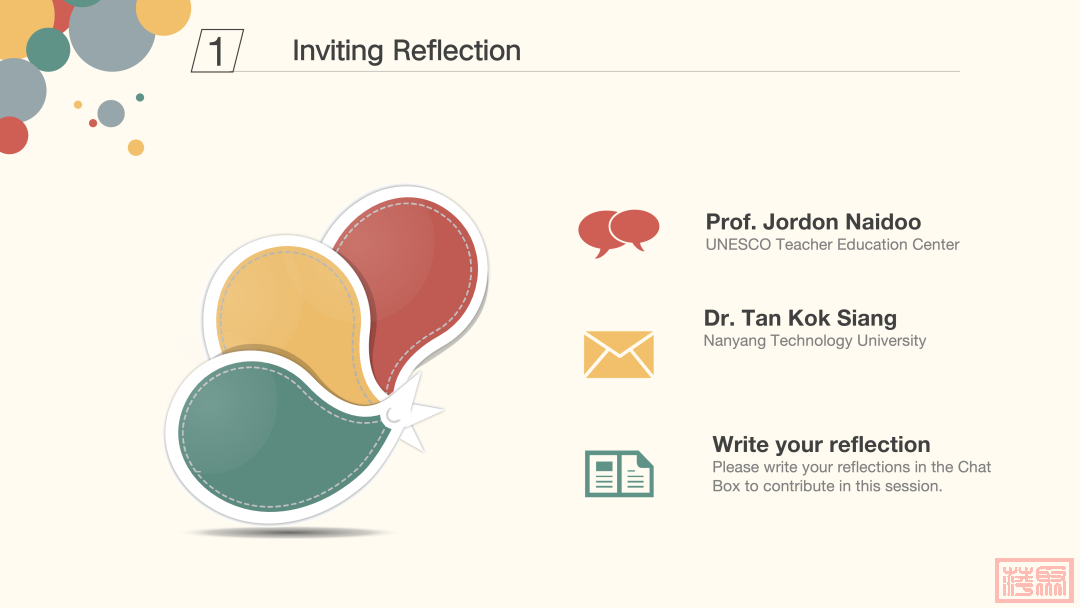
在反思与开放讨论环节,来自联合国教科文组织、多国教育实践一线的专家与教师围绕本次主题展开了深入交流。与会者普遍认同,本场讨论并非为了形成统一结论,而是通过跨文化、跨情境的经验分享,厘清关键分歧,识别技术应用中的现实边界。
作为首位讨论发言者,联合国教科文组织教师教育中心教授 Jordan Naidoo 在回应两位主讲嘉宾的报告时指出,AI 在 SEL 领域同时呈现出明显的“双重效应”。一方面,AI 通过相对一致、稳定的回应机制,可能为学生提供某种“标准化”的情绪支持,在一定程度上降低教师个体差异带来的不均衡影响;但另一方面,当社会情感支持被过度标准化,AI 也可能忽视学生所处的具体情境,给出过于泛化、甚至失真的回应。
他进一步强调,教育始终是一种高度依赖人际判断与关系理解的实践。当学生处于情绪脆弱状态时,AI 的建议并非总是可靠,而年轻学习者也未必具备辨别错误建议的能力。因此,AI 不应被视为替代教师的情感主体,而应与教师形成互补关系,在“人—技术”协同中发挥作用。
随后,第二位讨论发言者、新加坡国立教育学院(NIE)科学与化学教育高级讲师 Tan Kok Siang 博士结合自身一线教学与学生辅导经验,从学校实践角度补充了讨论的另一重要维度。
他指出,在日常教学中,教师既要承担学科教学任务,也要持续关注学生的情绪韧性与生活适应能力。在这一过程中,AI 技术或可在两个层面发挥支持作用:一是作为课堂层面的“前瞻性工具”,通过教学设计与学习平台,帮助学生在日常学习中逐步建立情绪调节与社会适应能力;二是在个别学生辅导中,协助教师更快整合学习记录、行为信息与成长轨迹,从而在有限时间内更好地理解学生处境。
但他同时提醒,SEL 属于高度情感性与模糊性的领域,其判断逻辑远不如学科知识清晰。如果过度依赖技术对学生情绪与行为的量化分析,甚至据此作出预测性判断,可能反而削弱学生的主体性,忽视成长过程中的复杂性与不确定性。因此,在 SEL 领域引入 AI,必须保持高度审慎,避免将技术工具误用为“替代性判断者”。
在开放讨论以及会议聊天室交流中,与会者进一步提出了一系列具有代表性的问题与关切:
AI 介入 SEL 的关键并非“是否使用”,而是“使用到何种程度、以何种方式使用”,这一判断始终是情境化的;
在基础设施薄弱或资源匮乏的国家与地区,AI 是否可能成为“被迫的唯一选择”,其公平性与可持续性如何保障;
在情绪与行为数据的采集与分析过程中,学生如何保有知情权、选择权与对算法解释的质询权,以及伦理边界应当如何设定。
围绕这些问题,程介明教授在讨论中进一步回应指出,将社会情感学习完全转化为可量化数据,本身就隐含着技术至上的风险;但与此同时,当学生已在现实中主动转向 AI 寻求支持时,教育者更需要思考如何理解、引导并介入这一过程,而非对其置身事外。关键不在于拒绝技术,而在于如何借助技术中已沉淀的大量专业经验,反过来丰富人与人之间的 SEL 实践。
讨论的最后,多位与会者形成共识:AI 支持 SEL 的前提,是教师专业判断、伦理治理与公共理解的同步提升。将 AI 素养纳入师范教育体系、在推广前进行充分的证据审查与公平性评估,并始终尊重学生的主体地位,是避免技术“喧宾夺主”的重要保障。
正如主持人所总结的那样,本场对话并未试图为复杂问题画上句号,而是希望通过持续交流,让这些问题保持在公共讨论之中——因为在 AI 与 SEL 的议题上,保持审慎与开放,本身就是一种负责任的教育选择。
III. Reflection and Dialogue: Clarifying Boundaries Through Difference, Building Understanding Through Exchange
During the reflection and open discussion session, experts and practitioners from UNESCO-affiliated institutions and diverse national education contexts engaged in in-depth dialogue around the seminar theme. Participants widely agreed that the discussion was not intended to reach a unified conclusion, but rather to surface key tensions, contextual differences, and practical boundaries through cross-cultural exchange.
As the first reflector, Jordan Naidoo, Professor at the UNESCO Teacher Education Centre, observed that AI in SEL demonstrates a clear dual effect. On one hand, consistent and stable AI responses may offer a form of standardized emotional support, potentially reducing disparities caused by variations in individual teachers’ practices. On the other hand, excessive standardization risks ignoring the specific contexts in which students’ emotional challenges arise, resulting in generic or shallow responses.
He emphasized that education remains a deeply relational practice, dependent on nuanced human judgment. When students are emotionally vulnerable, AI advice is not always reliable, and young learners may lack the capacity to discern misleading guidance. As such, AI should not be positioned as a replacement emotional agent, but as a complementary partner working alongside teachers. As he succinctly noted:
“We cannot rely wholly on the teacher, and we cannot rely wholly on AI.”
The second reflector, Tan Kok Siang, Senior Lecturer in Science and Chemical Education at the National Institute of Education (NIE), Singapore, enriched the discussion with frontline school experience. He highlighted that teachers must simultaneously address subject learning and students’ emotional resilience. In this context, AI may offer support at two levels: proactively, by embedding SEL-supportive design into classroom learning environments, and reactively, by helping teachers synthesize student records and learning histories to better understand individual situations within limited time.
At the same time, he cautioned that SEL operates in a highly affective and ambiguous domain. Over-reliance on quantified emotional or behavioral data—particularly for predictive purposes—may undermine student agency and oversimplify complex developmental processes. Introducing AI into SEL therefore demands particular care to avoid misusing technology as a substitute for professional judgment.
Further reflections emerged through open discussion and chat-based exchanges. Participants raised shared concerns, including: the extent and manner of AI use rather than a binary “yes or no”; the risk of AI becoming the only available option in low-infrastructure or resource-constrained contexts; and how students’ rights to informed consent, choice, and algorithmic explanation can be safeguarded when emotional and behavioral data are collected.
Responding to these concerns, Professor Cheng reiterated that attempts to fully quantify SEL reflect a form of technological overconfidence. Yet when students are already engaging with AI independently, educators must seek to understand and guide these interactions rather than ignore them. The key lies not in rejecting technology, but in drawing on the accumulated professional knowledge embedded within AI systems to enrich—rather than replace—human-centered SEL practice.
By the end of the discussion, a shared understanding emerged: AI can support SEL only when teacher professional judgment, ethical governance, and public understanding advance together. Embedding AI literacy into teacher education, requiring robust evidence and equity impact assessments before scaling, and consistently respecting student agency are essential safeguards against technology overshadowing educational purpose.
As summarized by the moderator, the dialogue deliberately left many questions open. In the realm of AI and SEL, maintaining openness and caution is itself a responsible educational stance.
四、从一次会议到一项机制:
持续对话的开始
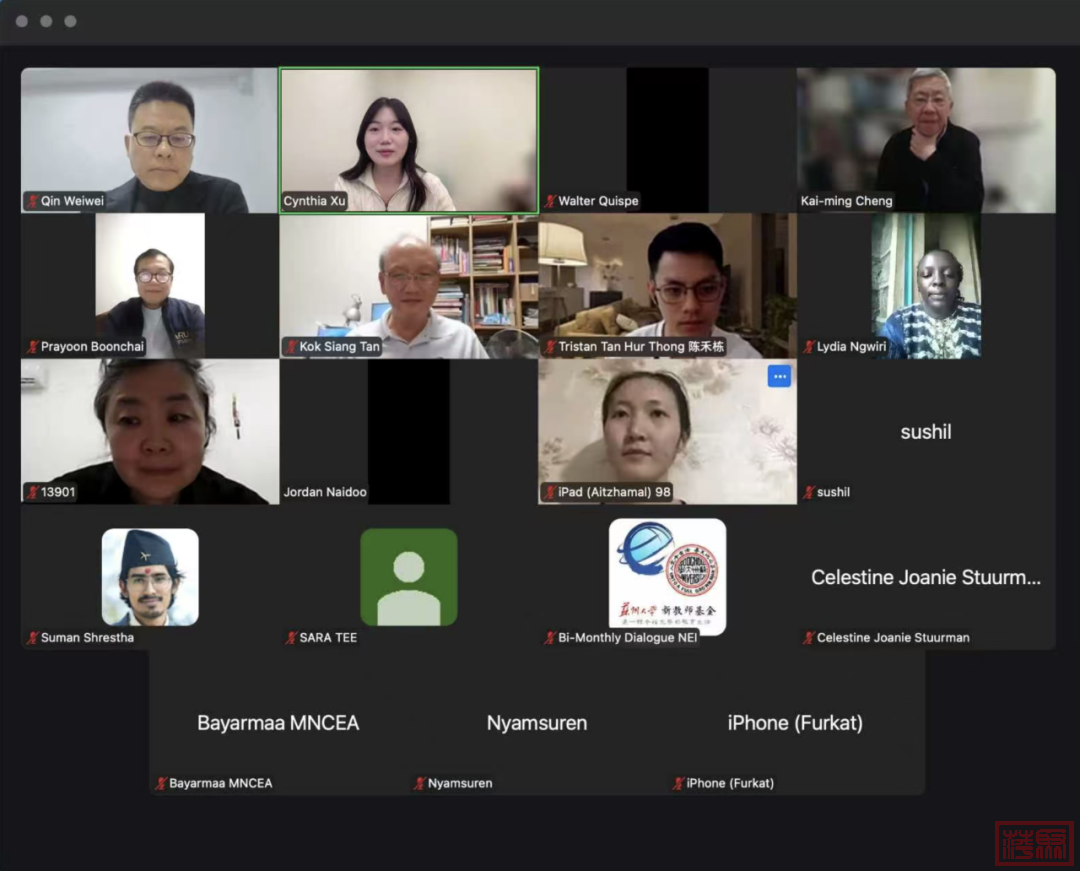
本次研讨会共吸引来自多个国家与地区的21 位教育工作者与研究者参与,涵盖基础教育、高等教育与教师教育等不同领域。与会者普遍反馈,会议所营造的非结论导向、重视伦理与实践复杂性的讨论氛围,为后续交流奠定了良好基础。
本次线上研讨会标志着新教师基金“一带一路”项目在原有国际研讨班基础上,正式启动双月线上学术与实践对话机制。项目团队表示,未来将持续围绕教师 AI 素养、SEL 的本土化实践、人机协作的教育边界等议题,邀请不同国家与背景的教育者共同参与讨论。
正如多位与会者所言,在人工智能快速发展的时代,教育并不急于给出答案,而更需要守住提问的能力、判断的责任与对人的信任。这场对话,正是一个开始。
IV. From a Single Dialogue to an Ongoing Conversation
The seminar brought together 21 educators and researchers from multiple countries and regions, spanning basic education, higher education, and teacher education. Participants widely noted that the non-conclusive, ethically attentive atmosphere of the dialogue provided a strong foundation for continued exchange.
This first online seminar formally launches the NEI Belt and Road Project’s bi-monthly online dialogue mechanism, extending its established international training programs into an ongoing platform for academic and practical exchange. The project team announced that future dialogues will continue to address topics such as teacher AI literacy, localized SEL practice, and the boundaries of human–AI collaboration in education, engaging educators from diverse national and professional backgrounds.
As several participants observed, in an era of rapid AI development, education need not rush to provide definitive answers. What matters more is preserving the capacity to ask meaningful questions, uphold responsible judgment, and sustain trust in human relationships. This dialogue marks a beginning.
END


喜报|新教师基金明师班两位学员入选2025年度“推动读书十大人物”请查收!新教师基金2025年度工作总结程介明:朱永新与新教育实验你好,我们是新教师基金
编辑:徐蒙奇 许译心审核:郭小月 |
|
 简体中文
简体中文 繁體中文
繁體中文 English
 Deutsch


 窥视卡
窥视卡 雷达卡
雷达卡 发表于 2026-1-21 12:48
 提升卡
提升卡 置顶卡
置顶卡 沉默卡
沉默卡 喧嚣卡
喧嚣卡 变色卡
变色卡 抢沙发
抢沙发 千斤顶
千斤顶 显身卡
显身卡